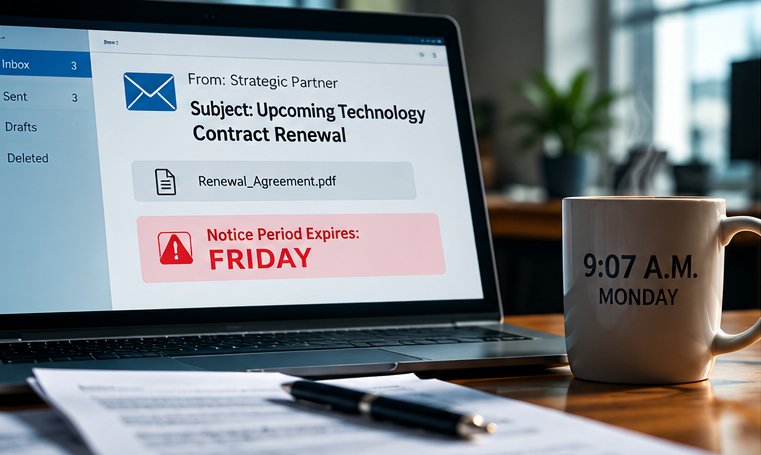
“Monday morning. A routine email turns a renewal into a four-day decision, and the clock starts working against us.”
Executive Technology Decision Series | Blog 2 of 3
MONDAY - 9:07 A.M. The Email
The email didn't look particularly important.
I had coffee in one hand and was scanning Monday morning messages when it arrived.
Subject: Upcoming Technology Contract Renewal
We had been with the supplier for years. The service worked. There had been occasional problems, but nothing serious enough to make changing providers a priority.
I opened the attachment.
Three-year renewal. Price increase. Some services I recognized immediately. Others I wasn't certain we were still using.
I forwarded it to our technology leader with a short note:
“Please review. Let’s discuss this week.”
His reply came eleven minutes later.
“We need to talk this morning.”
That got my attention.
By 10:30, he was sitting across from me.
“When does this renew?”
“End of next month.”
“Fine. We have time.”
He hesitated. “Not exactly.”
The contract required advance notice if we intended to make certain changes or terminate.
I looked at him. “When does that window close?”
He turned the agreement toward me.
Friday.
Four days.
Suddenly, this wasn’t a renewal. It was a decision.
The Clock Had Already Started
Technology contracts have a way of disappearing into the background while everyone focuses on running the business. Until they don’t.
The expiration date isn’t always the most important date. Notice provisions, renewal terms, migration requirements, implementation timelines and other contractual obligations can determine when your real decision window closes. That is why technology cost and vendor performance should be evaluated before a renewal becomes urgent, not after the clock has started working against you.
I called Finance. “How much have we spent with this supplier over the last three years?”
Then Operations. “Are we using everything we’re paying for?”
Then IT. “If we didn’t renew, what are our alternatives?”
By lunchtime, I had convinced myself we were taking control.
I gave the team what sounded like a perfectly reasonable assignment:
“Get me three alternatives by Thursday.”
WEDNESDAY - 6:38 P.M. Three Proposals

“Three proposals. Different pricing, different assumptions and not enough time to turn quotes into real options.”
My conference table was covered with proposals.
Three suppliers. Different pricing. Different architectures. Different implementation assumptions.
One included migration. Another didn’t. One looked considerably less expensive until we found several costs that weren’t included. Another appeared technically stronger, but nobody could tell me with confidence how long implementation would take.
Then there was our incumbent. They knew our environment. They knew our people. They knew something else, too.
We were running out of time.
We weren’t conducting a strategic evaluation anymore. We were trying to manufacture one in four days.
Three quotes are not the same thing as three choices.
A real evaluation would have considered total cost, implementation risk, contractual flexibility, integrations, business requirements, and whether the technology we bought three years ago still matched what the company needed today.
If the decision involved customer communications, we also needed to understand whether our existing contact center and customer-experience environment was actually producing the outcomes we expected.
We hadn’t done that work. Not because anyone had failed. Because until Monday morning, nobody thought we needed to.
Before Your Next Renewal Becomes a Deadline
Do you know which technology contracts renew during the next 12 months? More importantly, do you know when your leverage begins to disappear?
12 Questions Every Executive Should Ask was created to help leadership teams identify questions like these before they are sitting in front of a deadline.
Download the 12 Questions. Ask them while you still have choices.
FRIDAY - 4:43 P.M. The Signature Line
We had done it. At least, that’s what it felt like.
The incumbent supplier had made another concession. Finance calculated the difference.
$187,000 in savings over three years.
IT was comfortable. Operations preferred avoiding a migration. The supplier needed the agreement by 5:00.
Seventeen minutes.
The contract was sitting on the conference table. I turned to the last page.
There it was.
Blank signature line.
I picked up my pen.
There was a knock at the open door.
One of our board members stepped in. He was a former CEO, the kind of person who rarely dominated a meeting, but somehow managed to change one with a single question.
He wasn’t there about the contract. He glanced at the papers.
“What are you signing?”
“Technology renewal.”
“Big one?”
“Big enough. We got them down another $187,000.”
He nodded. “Good.”
Then he asked:
“What did the other two companies propose?”
“We looked at three alternatives.”
“That’s not what I asked.”
The room got quieter.
He pulled out a chair. “What did the other two companies propose?”
I explained that there hadn’t been enough time to complete a full evaluation. We had pricing. Preliminary technical information. Some migration estimates. But not enough to make a responsible comparison.
He looked at the contract. Then at me.
“Then how do you know you saved $187,000?”
I didn’t answer immediately. The pen was still in my hand.
4:51 P.M.
He wasn’t criticizing the supplier. And neither was I.
Our supplier had done exactly what a good supplier should do: defended its relationship, sharpened its pricing and worked to keep our business.
The uncomfortable issue wasn’t their behavior. It was ours.
Had anyone independently benchmarked the agreement? Had we conducted a meaningful vendor and technology evaluation? Were we renewing because this remained the best decision, or because changing direction had become too difficult?
Had anything changed in cybersecurity or compliance requirements since we signed the original agreement? Were there capabilities available today that didn’t exist three years ago?
What would migration really cost? What would staying cost?
Then the board member asked another question.
“What happens if you don’t sign it today?”
I looked toward our technology leader. He looked at Finance. Finance looked down at the agreement.
Nobody answered.
4:56 P.M.
Four minutes.
I could feel the decision changing.
Nothing about the contract had changed. Nothing about the supplier had changed.
What had changed was my confidence that I knew enough to put my name on it.
My phone rang. The supplier.
4:57.
I let it ring.
The board member didn’t say anything.
4:58.
The phone stopped. Then immediately started again.

“The final offer. A significant concession. A respected board member. A blank signature line. And less than two minutes to decide.”
I looked at the blank signature line.
Three years. Millions of dollars. One signature. And less than two minutes to decide.
The pen suddenly felt much heavier than it had fifteen minutes earlier.
Did I Sign It?
I’m not going to tell you. Not yet.
Because whether I signed that contract isn’t the most important question.
The important question is what you would have done sitting in that chair at 4:58 P.M.
Would you sign because your team worked hard? Because the supplier reduced the price? Because changing providers carried risk? Because the deadline was real?
Or could you put the pen down knowing you had started early enough, evaluated the alternatives, understood the risks, tested the assumptions, and gathered enough evidence to defend the decision?
There is an enormous difference between approving a technology decision and being able to defend why you made it.
Don’t Wait Until the Signature Line
The worst time to discover that you don’t have enough information is when the contract is already in front of you.
Real Resultz created 12 Questions Every Executive Should Ask to help executives challenge technology assumptions before the deadline, before the renewal, and before the signature.
Some answers may confirm you’re making exactly the right decision. Others may tell you that you need more time. Either result is valuable.
Because when your name is going on the line, “I think this is right” may not be enough.
Download 12 Questions Every Executive Should Ask
Before you buy. Before you renew. Before you assume. Ask better questions.
Advisory First Solutions Second