
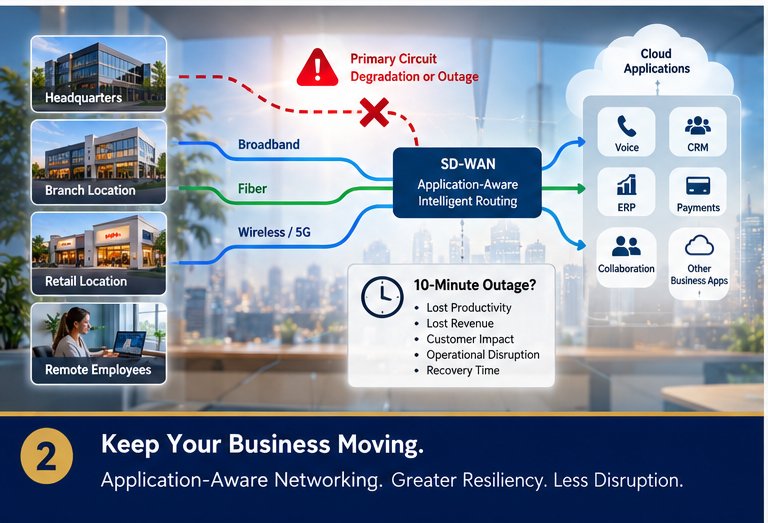
“SD-WAN connects offices, cloud applications, remote users, and redundant network paths.”
A slow network is not an IT inconvenience. It can become a business problem.
When a customer service platform freezes, a video meeting drops, a payment system cannot connect, or employees wait for a cloud application to respond, the cost shows up somewhere. Productivity falls. Customers wait. IT teams chase problems. Leadership pays for network services without always knowing whether those services are delivering the performance the business actually needs.
That is where Software-Defined Wide Area Networking, or SD-WAN, deserves a closer look.
SD-WAN can give organizations more control over how network traffic moves between offices, cloud platforms, data centers, remote locations, and critical business applications. But the technology itself is not the objective.
The objective is better business performance.
At Real Resultz, that is why we evaluate SD-WAN solutions by starting with the business outcome, not the product.
What Problem Is SD-WAN Really Solving?
Traditional wide area networks were designed for a different operating model. Applications often lived inside the corporate network, employees worked primarily from company locations, and traffic patterns were more predictable.
Today, businesses rely on Microsoft 365, cloud applications, customer relationship management systems, voice and video, contact center platforms, remote employees, branch offices, mobile users, and third-party applications. The network has to support all of it.
SD-WAN uses software-based controls to manage network connections and route traffic according to application requirements, business policies, and available connectivity. Instead of treating every packet of traffic the same, the network can make better decisions about which path should carry a critical application.
That sounds technical. The business impact is much simpler: the right traffic can get the right priority at the right time.
1. Improve the Performance of the Applications That Matter
Not every application has the same value to the business. A customer call, payment transaction, cloud-based ERP session, or executive video conference may be far more important than a routine software update.
SD-WAN can prioritize critical applications and direct traffic across available network paths based on configured policies and current connection conditions. That can improve how effectively a company uses the bandwidth it is already paying for.
This becomes increasingly important as organizations move more applications and workloads into cloud environments. Network strategy and cloud strategy should support each other, not operate as separate decisions.
2. Build Resiliency Before the Network Fails
Business continuity should not begin after an outage.
If a company depends on one network path and that connection fails, employees may lose access to the applications they need to serve customers, process transactions, communicate, or operate the business.
With properly designed redundant connections, SD-WAN can detect performance problems and move traffic to another available path. That does not make a network failure-proof. It does give the organization another way to protect operations when a carrier or circuit has a problem.
For a multi-location company, that resiliency can be the difference between a network event that is barely noticed and one that disrupts the business.
3. Control Network Costs Without Sacrificing Performance
Cost reduction is one of the reasons companies investigate SD-WAN, but it should not be approached as a race to buy the cheapest circuit.
Traditional WAN environments may rely heavily on dedicated circuits. SD-WAN can allow an organization to combine fiber, broadband, dedicated services, and other connectivity options based on the requirements of each location.
The financial question is not simply, "Can we lower the monthly circuit bill?"
The better question is, "Can we improve performance and resiliency while creating a more disciplined total network cost?"
Actual savings depend on the current infrastructure, carrier pricing, licensing, implementation costs, bandwidth requirements, and the level of redundancy the business needs. That is why the financial model should be evaluated before a migration decision is made.
Schedule a Complimentary SD-WAN Strategy Conversation
4. Simplify a Network That Has Become Too Complicated
Growth creates complexity. A company adds a branch. Then another. It acquires a business. It adds remote employees. It adopts new cloud applications. Over time, the network can become a collection of circuits, hardware, contracts, configurations, and workarounds.
SD-WAN provides centralized management that can make it easier to apply policies, monitor performance, troubleshoot problems, and support multiple locations.
For IT leadership, that can mean better visibility. For the C-suite, it can mean fewer surprises and a clearer understanding of whether the network is supporting growth or quietly becoming an operational constraint.
5. Connect Network Modernization to Cybersecurity
SD-WAN and cybersecurity are related, but they are not the same thing.
SD-WAN can support segmentation, policy enforcement, encryption, and integration with security technologies. It does not automatically provide every security control an organization needs.
That is why network modernization should be evaluated alongside the organization's broader cybersecurity strategy. A faster network that introduces unmanaged risk is not a successful technology outcome.
Security requirements should include identity, access controls, firewalls, threat protection, monitoring, segmentation, and the organization's compliance obligations.
Where SASE Fits Into the Conversation
Secure Access Service Edge, or SASE, takes the conversation beyond network routing. SASE brings networking and cloud-delivered security capabilities together within a broader architecture.
For organizations with distributed offices, remote employees, cloud applications, and users connecting from many locations, that combination may make sense.
Real Resultz evaluates SASE and SD-WAN together when the business requirements call for both network modernization and a more integrated security architecture.
The important point is not to assume that every company needs the same architecture. Existing security investments, applications, compliance requirements, locations, users, and business objectives all matter.
“Business outcome view showing Performance, Resiliency, Cost Control, Visibility, and Security.”
SD-WAN Can Affect More Than the IT Department
A network decision can reach almost every part of the organization.
The CFO sees carrier costs, contract commitments, and the financial impact of downtime. The CIO sees performance, complexity, security, and scalability. Operations sees whether locations and employees can reliably do their jobs. Sales and customer service see whether communications and customer-facing systems work when they are needed.
For organizations running voice, omnichannel service, or cloud-based customer engagement platforms, network performance can directly affect the contact center experience.
That is why SD-WAN should not be evaluated as a router replacement project. It should be evaluated as a business infrastructure decision.
What Should You Evaluate Before Choosing an SD-WAN Solution?
Before selecting a provider, start with the current environment and the outcomes the business expects to achieve.
- Assess existing circuits, bandwidth, recurring costs, outages, and performance problems.
- Identify the applications that are truly critical to revenue, operations, customers, and employees.
- Determine where redundancy is required and what level of downtime the business can tolerate.
- Evaluate security controls, segmentation, identity, encryption, and whether SASE should be part of the architecture.
- Compare available connectivity options by location rather than forcing every site into the same design.
- Understand licensing, hardware, installation, support, carrier, and ongoing management costs.
- Plan the migration in phases and establish a rollback strategy before deployment.
Organizations in regulated industries should also evaluate how network design supports their compliance requirements, rather than treating compliance as a separate project after the network is deployed.
The Vendor Should Not Define the Strategy
This is where many technology projects go wrong.
A carrier recommends its SD-WAN platform. A managed service provider recommends another. A security company recommends its preferred architecture. Each may have a capable solution, but that does not mean its solution is automatically right for your business.
The business requirements should define the architecture first.
Then the technology and provider should be selected.
Real Resultz takes a vendor-agnostic approach because our job is not to force a company into one manufacturer's roadmap. We help leadership understand the current environment, define measurable objectives, compare appropriate options, evaluate total cost, identify risk, and make a decision that can be defended financially and operationally.
The Question Leadership Should Ask
Do not ask, "Do we need SD-WAN?"
Ask:
"What is our current network costing the business in performance, downtime, complexity, risk, and unnecessary expense, and what measurable improvement should we expect from changing it?"
That question changes the conversation.
Technology should earn its place in the business. If SD-WAN can improve application performance, strengthen resiliency, simplify operations, reduce unnecessary cost, and support a more secure architecture, then it may deserve that place.
If it cannot, buying it because it is the latest networking technology is not a strategy.

“Executive reviewing an SD-WAN decision scorecard comparing business outcomes, risk, and total cost.”
How Real Resultz Can Help
Real Resultz begins with the business, not the vendor.
We evaluate your current network, business applications, locations, carrier environment, security requirements, costs, growth plans, and operational risks. Then we help determine whether SD-WAN, SASE, a different connectivity strategy, or a combination of technologies is the right answer.
Our approach is simple: Advisory First - Solutions Second. The recommendation has to support a measurable business outcome.
Talk With Real Resultz About Your Network Strategy
Frequently Asked Questions
What is SD-WAN?
SD-WAN, or Software-Defined Wide Area Networking, uses software-based controls to manage network connections and route traffic between locations, cloud services, data centers, and users according to defined policies and application requirements.
Can SD-WAN improve network performance?
It can. SD-WAN can prioritize important applications and select among available network paths based on configured policies and connection conditions. Results depend on the underlying circuits, architecture, configuration, and application requirements.
Can SD-WAN reduce network costs?
Potentially. SD-WAN can give businesses more flexibility in how they combine broadband, fiber, dedicated circuits, and other connectivity. The real financial result depends on existing contracts, provider pricing, licensing, implementation, support, and resiliency requirements.
Does SD-WAN replace cybersecurity?
No. SD-WAN can support security policies and integrate with security technologies, but it is not a substitute for a complete cybersecurity strategy.
What is the difference between SD-WAN and SASE?
SD-WAN primarily focuses on network connectivity and traffic management. SASE combines networking with cloud-delivered security capabilities to support secure access for users, devices, applications, and locations.
Is SD-WAN only for large enterprises?
No. Small and midsize businesses with multiple locations, cloud applications, remote employees, critical customer communications, or changing bandwidth requirements may also benefit. The architecture should match the business need and budget.
Conclusion
Reliable connectivity is no longer background infrastructure. It is part of how a business serves customers, supports employees, protects operations, and grows.
SD-WAN can be a powerful tool, but only when the strategy begins with measurable business outcomes.
Advisory First - Solutions Second
Measured - Experienced - Achieved