Executive Technology Decision Series | Blog 1 of 3
2:17 A.M. The First Awakening!
I don't remember what I was dreaming about. I only remember how violently it ended.
I was in such a deep sleep that when my eyes opened, I didn't know where I was. The room was dark. Everything was quiet. I stared at the ceiling, trying to understand what had pulled me out of sleep.
Then four words surfaced: CAN I PROVE IT? What, What can I prove? I said to myself.
I looked at the clock. 2:17 A.M. Prove what? It took several minutes for my thoughts to gather.
Something deep inside my head would not let go.
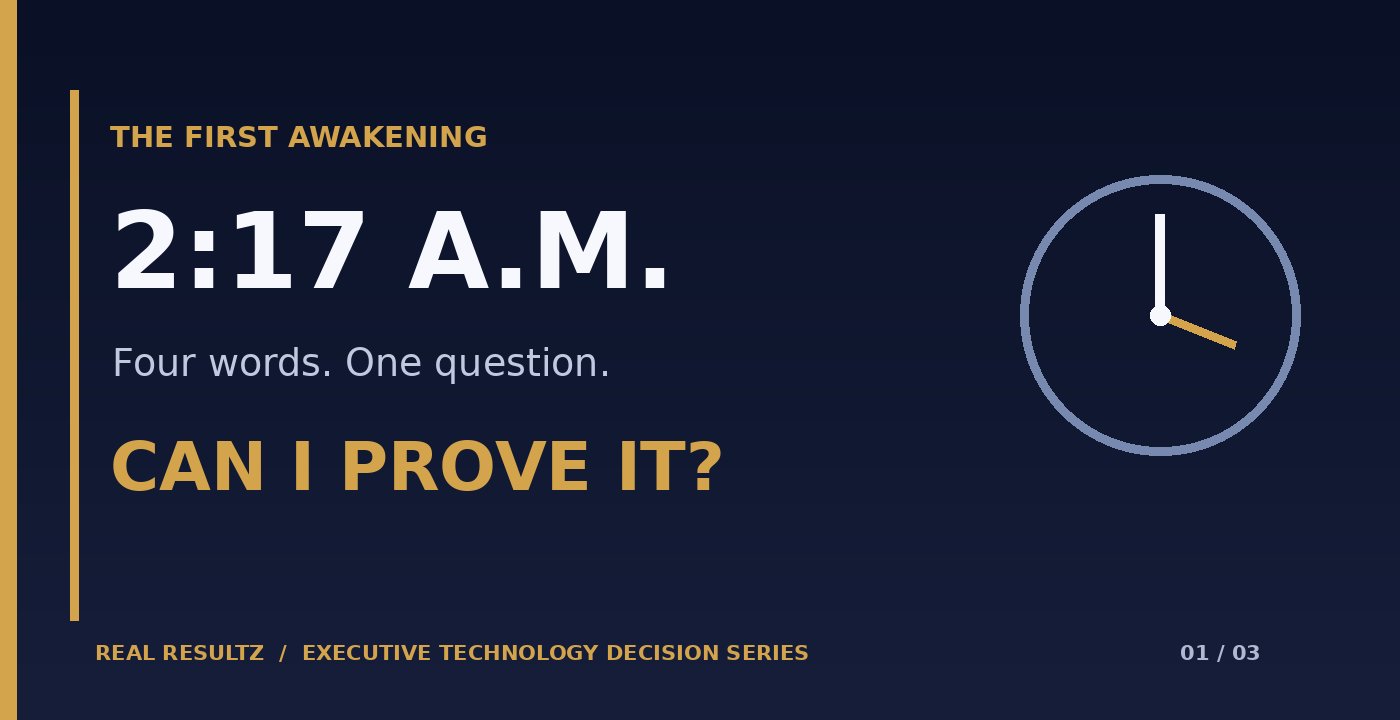
“At 2:17 a.m., four words turn ordinary executive confidence into an uncomfortable question.”
We spend heavily on technology. Can I prove it delivers what we expected? Our vendors say our pricing is competitive. Can I prove it? We have security tools. Can I prove they work? We have regulatory obligations. Can I demonstrate our compliance readiness rather than assume someone else has it covered?
We back up our data. Could I prove we could restore the business tomorrow morning?
The Comfortable Assumption
When email works, calls connect, customers get served, and dashboards glow green, everything feels under control. We have capable people, contracts, reports, and data backup and recovery systems. But a report that says “successful” is not the same as a successful real-world test.
When did someone independently challenge the vendor recommendation? When did leadership ask whether a critical application could be recovered, not just whether its files were copied? Who has tested the dependencies that keep customers connected?
I had no immediate answers. Eventually, exhaustion won. I drifted into another deep sleep.
BAM! The Second Awakening
In the nightmare, our company was under cyberattack. Systems stopped responding. Employees scrambled. Customers wanted answers. Someone shouted, “We're protected. We back up every hour!”
Then came the question nobody wanted: Have we ever tested whether everything can actually be restored?
We had recently launched a new customer experience (CX) service. We tested its features and celebrated the rollout. But had we tested every integration, customer-data connection, workflow, permission, and recovery dependency? Were they all protected and backed up? Could we reconstruct the service, or just recover pieces of it?
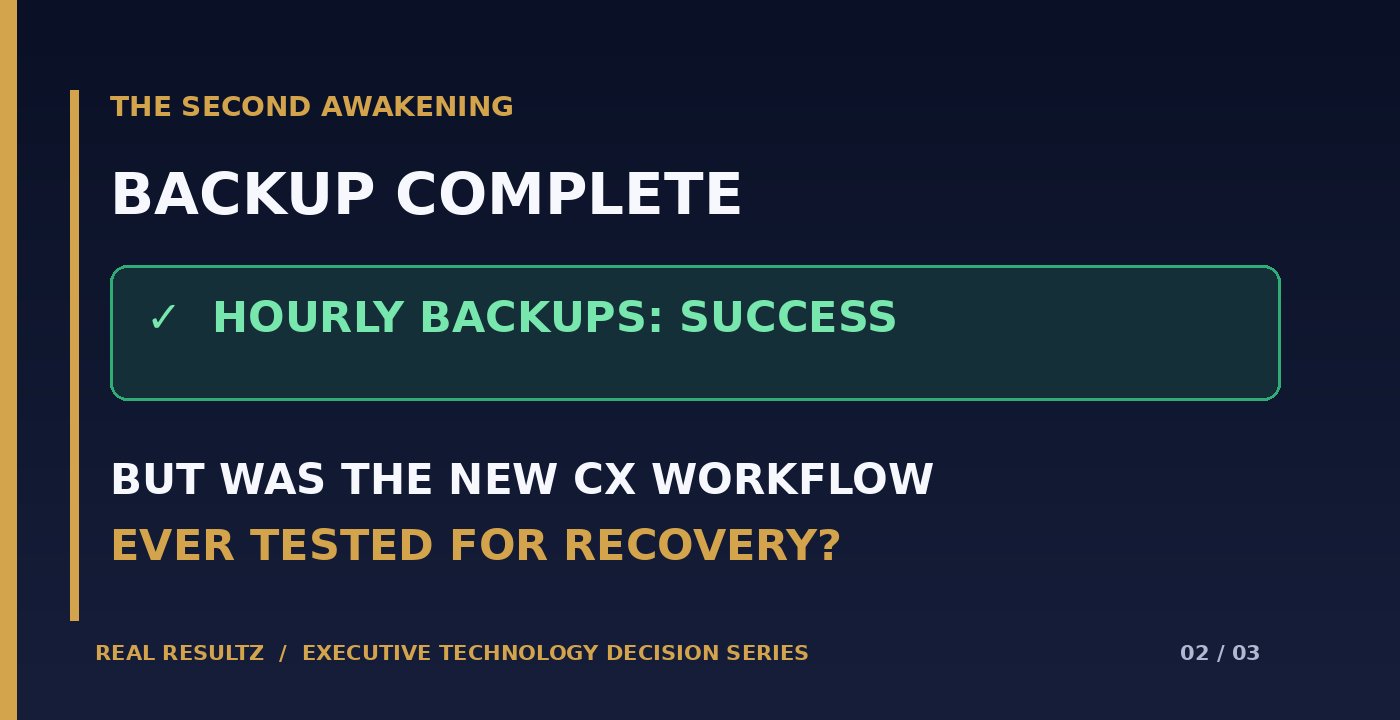
“Hourly backups can succeed while a newly integrated customer-experience workflow remains untested for full recovery.”
I sat straight up in bed with a jolt. My spouse stirred. “Everything okay?”
“Just a dream,” I said. But I reached for a pen and wrote one note: CAN I PROVE IT?
Could Your Leadership Team Prove It?
Real Resultz created “12 Questions Every Executive Should Ask” to uncover the assumptions hidden inside everyday technology decisions. Take the test before a real incident forces the conversation.
DOWNLOAD: 12 Questions Every Executive Should Ask
I lay back down. Sleep returned. So did the nightmare.
The Third Awakening! $10,000,000???
This time, the screen showed a ransom demand: $10,000,000.
Systems were inaccessible. Operations were frozen. Customers were calling. Employees could not do their jobs. The details were so real that I could hear the panic in every conversation.
Our cybersecurity services and controls were supposed to protect us. Our recovery plan was supposed to save us. Our compliance procedures were supposed to guide our response. Yet nobody could show me a complete, tested path back to normal operations.
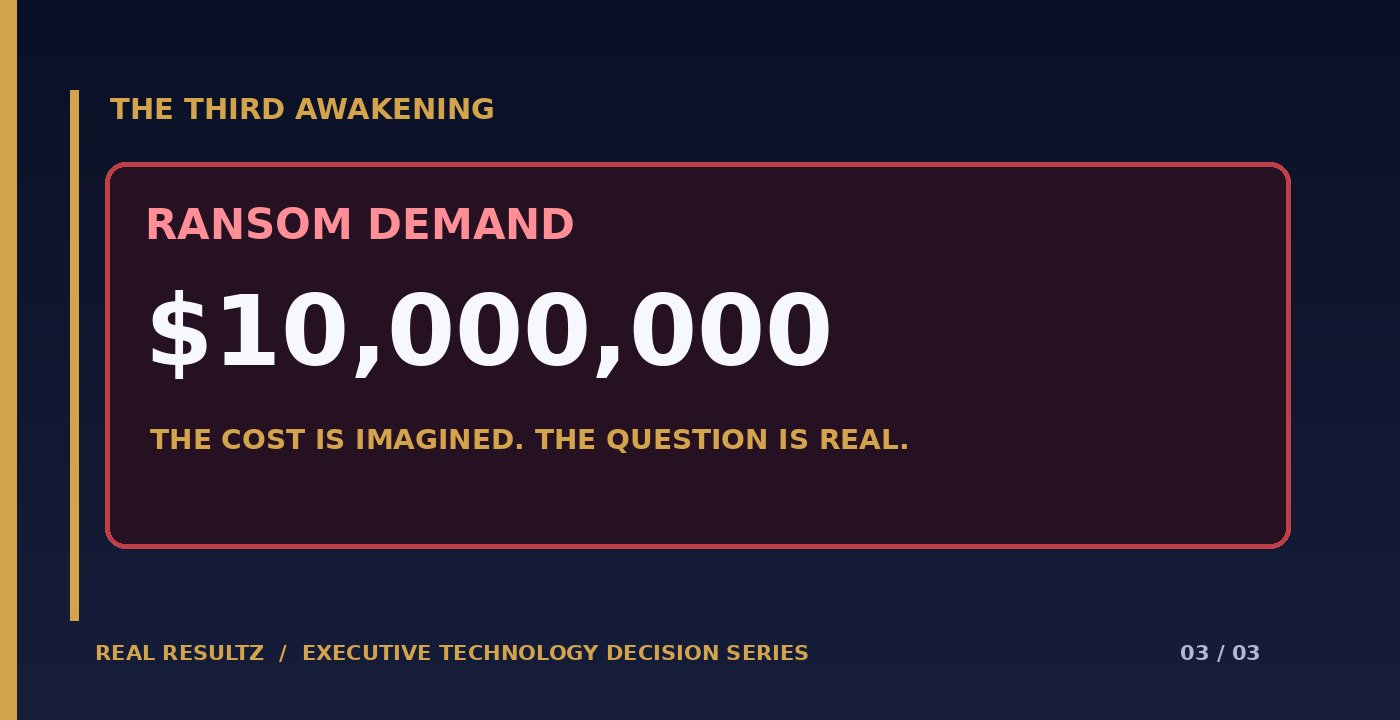
“The $10 million demand belongs to the nightmare. The need to validate recovery and protection belongs to the boardroom.”
Those four words returned much louder than before: CAN I PROVE IT?
I woke in a cold sweat. My spouse was fully awake. “You were talking in your sleep and tossing all over the bed.” I was panic-stricken. This was not a real attack; it was a nightmare. But the questions it raised were real.
What the Nightmare Was Really About
A healthy-looking contact center performance report does not prove that every connected process can survive a disruption. An AI strategy may promise efficiency without establishing who uses the tools, what data they touch, or who approves the risk. A green security dashboard does not prove the business can recover.
The danger is not that every assumption is wrong. It is that nobody has distinguished an assumption from verified evidence. Executives do not need to become engineers. They need to know which answers can be demonstrated, who owns them, and when they were last tested.
The most dangerous answer may not be NO. It may be “I think so.”
Before the Next 2:17 A.M.
There are 12 questions every executive should be able to ask. I'm not giving you all 12 here. The value is in taking them to your leadership team and discovering which answers stand up to scrutiny.
There Are 12 Questions. How Many Can You Prove?
Download 12 Questions Every Executive Should Ask. Ask the questions. Request the evidence. Find the gaps while you still have choices. Before you buy. Before you renew. Before you assume.
Download the free report here: 12 Questions Every Executive Should Ask
CAN I PROVE IT?