
Rising costs and buyer willingness to switch are turning technology renewals into strategic decision points.
Picture a renewal notice landing in someone's inbox on an ordinary Tuesday. The vendor has attached a quote. Procurement has a deadline. The conversation quickly narrows to one question: accept the number or try to negotiate it down.
By the time that quote arrives, much of your leverage is already gone.
A renewal you have not reviewed is not neutral. It can quietly lock today's pricing, yesterday's requirements, and tomorrow's limitations into another contract term.
At Real Resultz, we believe a renewal should begin with questions, not a product. Advisory First. Solutions Second. So before the next quote arrives, ask a more important question: is this technology still earning its place in the business?
Is Loyalty Still Part of Your Buying Strategy?
The 2026-27 Real Resultz Tech Trends Report, built on independent research by Redpoint Insights, puts numbers around changing renewal behavior. Eighty-four percent of buyers are open to switching vendors at renewal. Eighty-seven percent report increased renewal costs over the past 12 months. And one in three regretted a major technology purchase in the last 24 months.
Read together, those findings point to a meaningful shift. For many organizations, what looks like vendor loyalty may actually be inertia. The solution is already installed. Employees know it. Changing vendors takes time. So the contract renews even when the business case for it has weakened.
Ask yourself: if your largest technology vendor called today and said the contract was ending, would you stay because the solution is still the best fit - or because switching feels like work?
What Does Technology Purchase Regret Look Like?
The research identifies several reasons buyers regret technology purchases. Among the leading causes are solutions not meeting expectations, changing business needs, higher-than-expected total cost, vendors overpromising capabilities, and integration challenges.
None of those problems suddenly appears on renewal day. They build quietly during the life of the contract. Renewal is simply the moment when the organization has an opportunity to do something about them.
What did you expect when you signed? Has the solution delivered? How has your business changed? Which capabilities are you paying for but not using? What do you need now that the current solution cannot provide? A contract that no longer matches the business is not a bargain simply because the vendor offers a discount.
Why Do Renewal Conversations Start Too Late?
Often, nobody truly owns the renewal calendar. One person signed the agreement, another team uses the service, and a third pays the invoice. IT sees a technical platform. Finance sees a recurring expense. Operations sees a service that appears to be working. Each assumes someone else is watching the contract date.
The result is predictable: everyone finally looks at the same agreement when the renewal quote arrives. At that point, options are limited and negotiating leverage has already started to disappear.
Who owns your technology renewal calendar today? Could your leadership team name the next three major contracts coming due - and the dates when decisions actually need to be made?
When Should the Real Conversation Start?
Most renewal conversations begin with a quote. That is the wrong starting point because a quote forces the business to react. We recommend beginning the review 6 to 12 months before renewal. The first objective is not to negotiate. It is to evaluate.
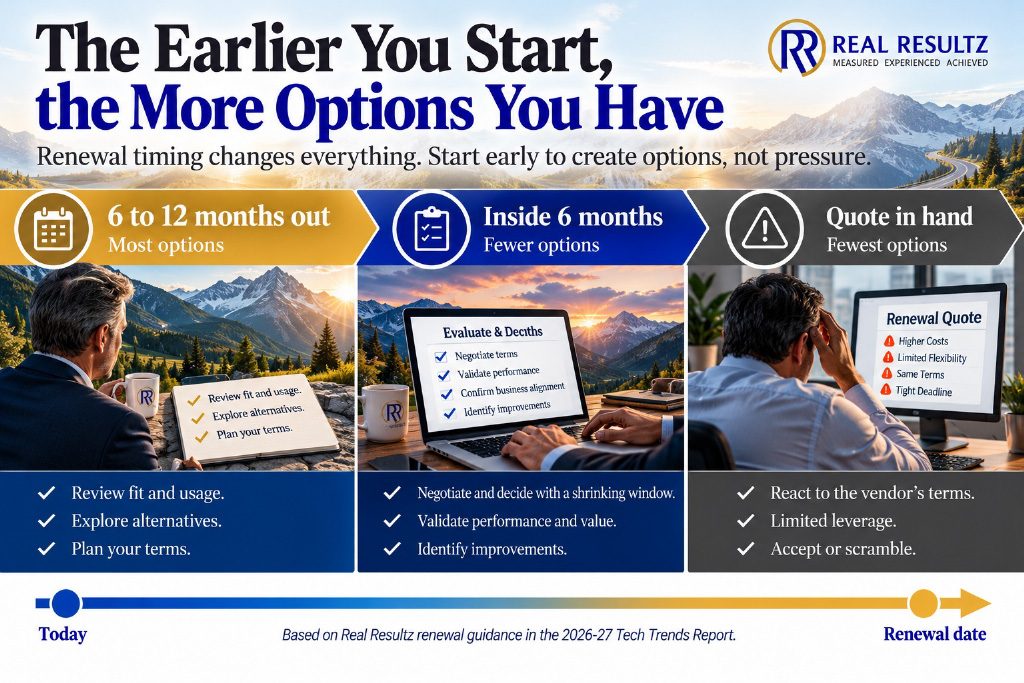
Starting 6-12 months before renewal preserves options, leverage, and time to evaluate alternatives.
Starting early creates options. You can validate usage, assess performance, compare the solution with current business requirements, explore alternatives, plan migration if necessary, and negotiate from a position of knowledge. Starting late often reduces the decision to two choices: accept or scramble.
This applies far beyond one category of technology. Cloud and software subscriptions, communications platforms, contact center solutions, network circuits, wireless services, cybersecurity tools, and other recurring technology agreements all have decision dates. The important question is whether anyone is managing those dates strategically.
A Better Renewal Process: Map. Evaluate. Improve.
A strategic renewal review does not have to become a massive consulting project. Start with the top two or three technology renewals on your calendar and use three steps:
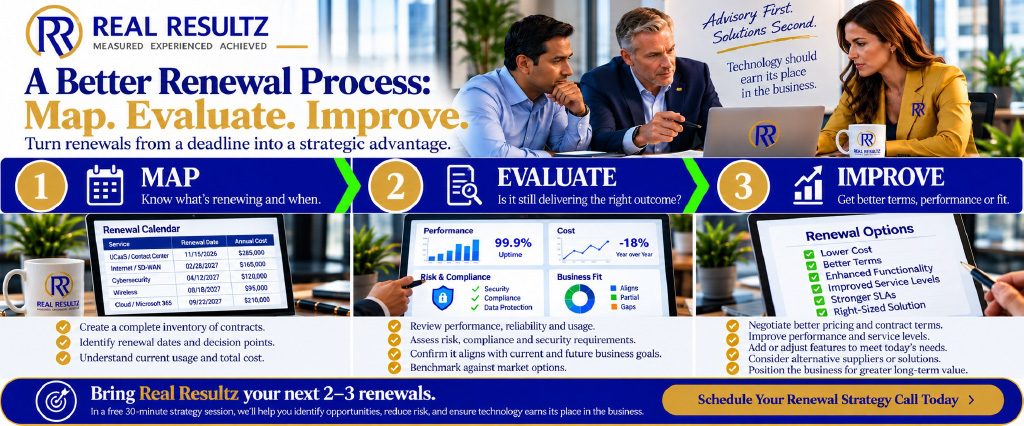
Map upcoming renewals. Evaluate business fit and performance. Improve terms, cost, or capabilities before the decision window closes.
The goal is not disruption for its own sake. A disciplined review may confirm that renewing with the existing vendor is the best decision. It may uncover better terms. Or it may reveal that the business has outgrown the current solution. The important difference is that you are making an active decision instead of allowing a deadline to make it for you.
An independent, vendor-agnostic technology advisor can bring another perspective to that decision - evaluating fit, cost, performance, risk, alternatives, and the business outcome before a new term begins.
Your Next Step
Bring us your next two or three technology renewals. In a free 30-minute strategy session, Real Resultz will help you identify which contracts deserve a closer look before the decision window starts closing.
Technology should earn its place in the business. Your renewal date is one of the best opportunities to make sure it still does.
Advisory First. Solutions Second.
Call Real Resultz at 833-421-5678 to schedule your strategy session.
Source: 2026-27 Real Resultz Technology Trends Report. Research conducted by Redpoint Insights: 503 U.S. IT buyers at mid-market and enterprise organizations (95% confidence level, margin of error under 3%) and 452 technology advisors.