
Artificial intelligence (AI) is changing how small and midsized businesses operate. But the opportunity is not simply to use more AI. The real opportunity is to use AI where it can produce measurable business results.
That distinction is important. AI is not a business outcome. It is an enabling technology. Its value should be measured by what it accomplishes for the business: lower operating costs, greater employee capacity, faster decisions, improved customer experiences, reduced risk, or sustainable revenue growth.
For small and midsized businesses with limited people, budgets, and technology resources, that outcome-first approach may be the difference between AI becoming a competitive advantage and becoming another technology expense.
Stop Measuring Hard Work by Hours
Small business owners understand hard work. The problem is that growth can eventually create more administrative work than an owner or small team can efficiently absorb. AI offers an opportunity to change that equation.
Recent small-business research found that 91% of respondents said AI reduced the time they spend on administrative work, while 73% reported using AI across core business operations.¹
The business result is not simply time saved. The potential business outcome is what that recovered time makes possible. An owner might spend more time developing customers. A salesperson can spend more time selling. An operations leader can concentrate on improving performance.
Employees can redirect their attention from repetitive work to activities requiring judgment, creativity, relationships, and experience.
That is leverage. A disciplined Artificial Intelligence strategy should begin by identifying those opportunities, not by selecting technology.
Growth Does Not Always Require More Headcount
AI may also change the economics of scaling a small business.
Research involving solopreneurs found that 74% said AI helped them scale without hiring full-time employees, and 72% said they would not have grown as quickly without AI.²
That does not mean replacing people with technology. It means determining which work truly requires people.
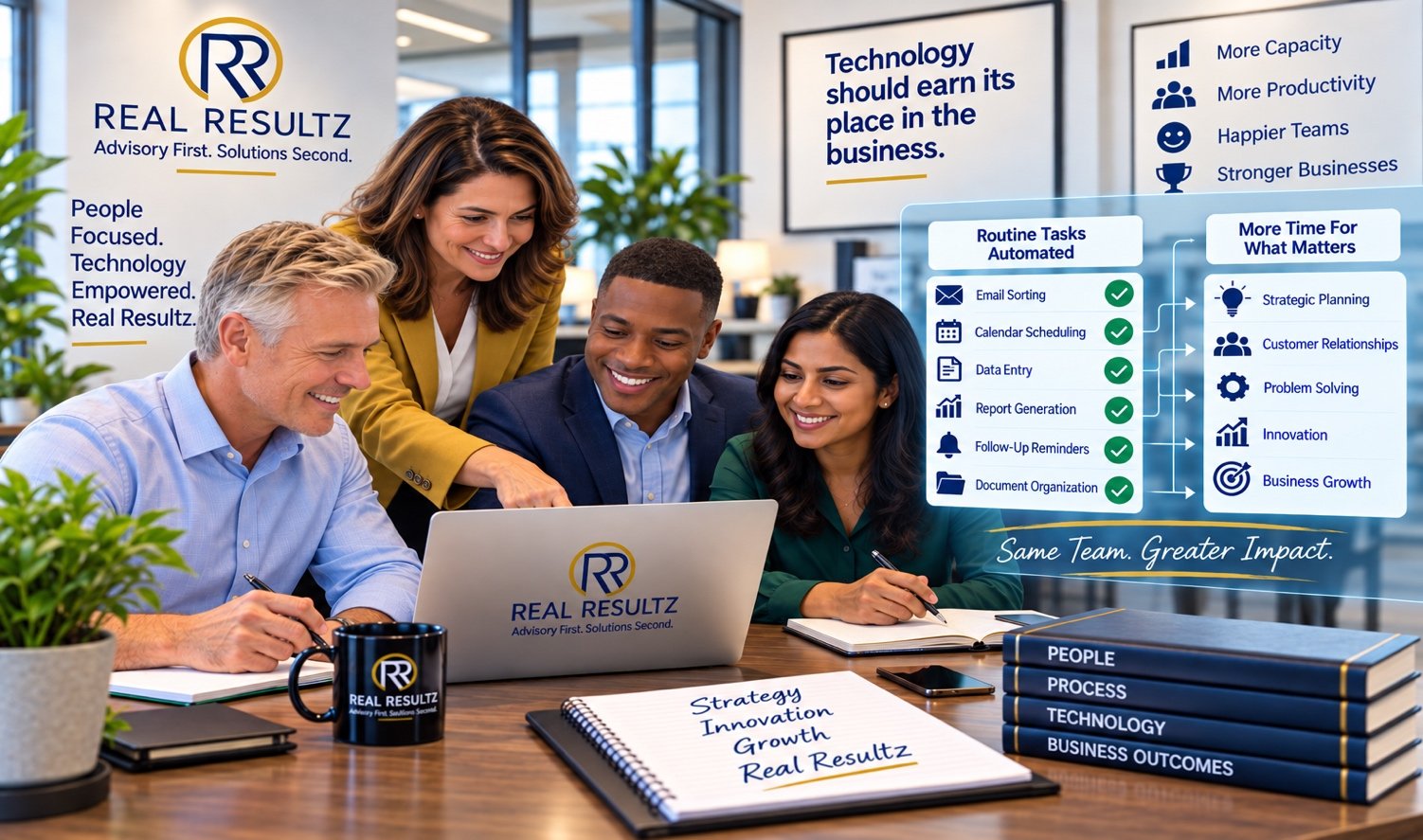
Scheduling, meeting summaries, initial drafts, repetitive communications, information organization, workflow preparation, and routine analysis can consume valuable employee capacity. Reducing that workload can allow the same organization to handle more business without creating a proportional increase in overhead.
Customer service provides another example. Properly designed Contact Center solutions can use AI to support employees, identify patterns, summarize interactions, and improve access to information while keeping people involved when empathy, experience, and judgment matter.
REAL RESULTZ INSIGHT: Before buying another AI solution, identify the business result you expect it to produce. If the expected outcome cannot be defined and measured, the investment probably is not ready to be made.
Experiment, But Put Guardrails Around It
One of the strongest lessons for SMB leaders is that employees may already be experimenting with AI.
More than half of SMB employees surveyed said their organizations were prioritizing exploration and use of generative AI. Yet only 65% of SMBs reported having formal guidelines governing employee AI use.³
That creates a business issue that extends beyond productivity.
What information are employees entering? Is customer information protected? Is proprietary business information exposed? Can the output be trusted? Who verifies its accuracy?
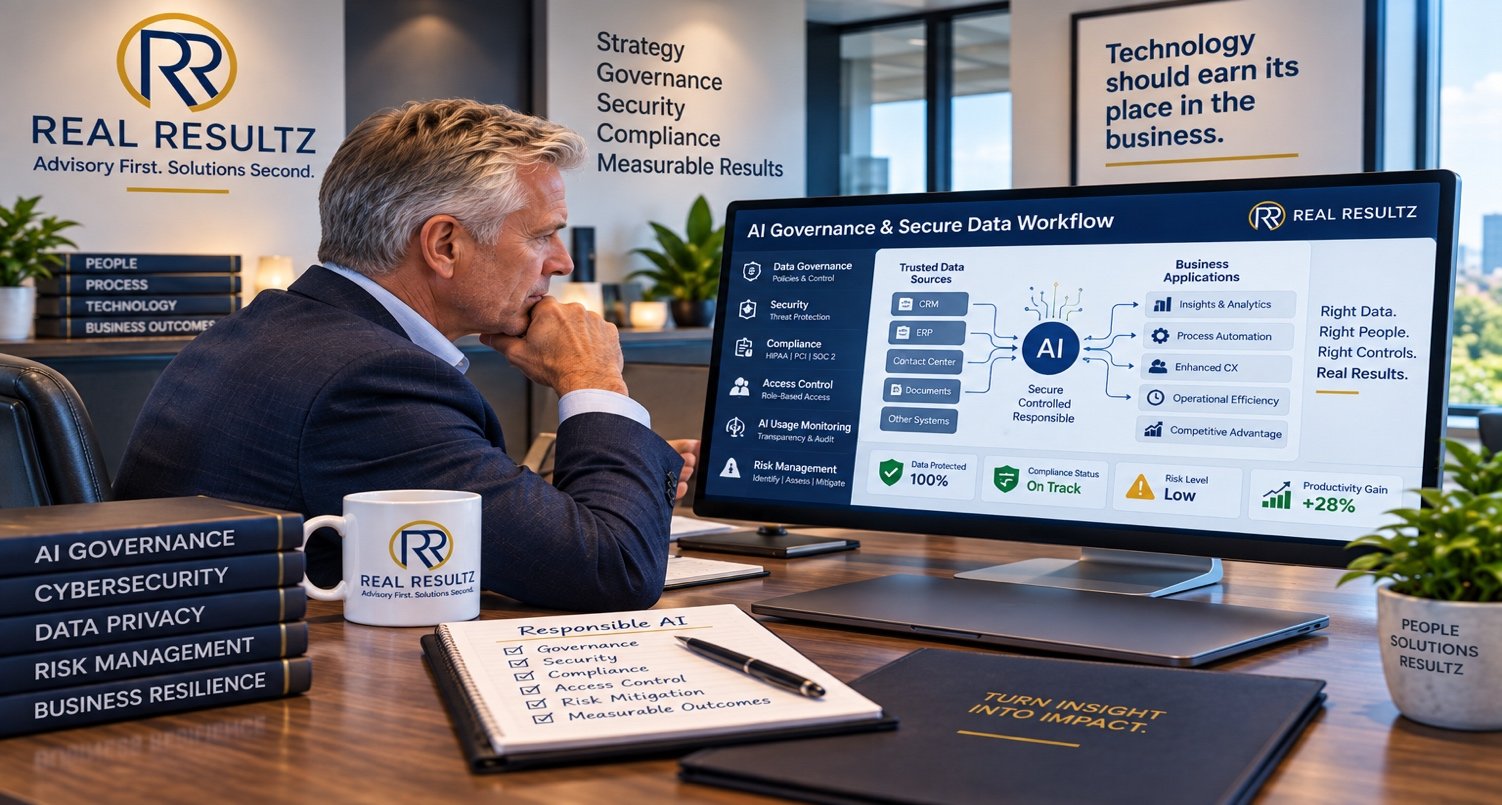
AI strategy therefore needs to intersect with Cybersecurity, Compliance, data governance, and employee policy.
The objective should not be to stop experimentation. It should be to establish enough governance that experimentation can occur responsibly.
Curiosity Can Become a Competitive Advantage
Businesses do not need to master AI before benefiting from it.
In fact, 59% of small businesses surveyed said their growth would not have been possible without AI. Among solopreneurs, that figure increased to 64%.⁴
The lesson is not that every company needs more AI. It is that small, disciplined experimentation can reveal where AI actually creates value.
Start with a business problem. Test a contained use case. Establish a baseline. Measure the result.
Did response time improve? Did an employee recover five hours per week? Did proposal turnaround decrease? Were customer inquiries resolved faster? Did the business increase capacity without adding overhead?
If the answer is yes, expand intelligently. If the answer is no, stop or change direction.
The underlying technology environment matters too. AI depends on accessible, accurate, secure information. A company's Cloud Services, applications, infrastructure, cybersecurity, and data practices can determine whether an AI initiative produces reliable results or creates additional complexity.
The Better Question: "Where Can AI Produce a Measurable Business Outcome?"
Instead of asking, "Where can we use AI?" executives should ask a more disciplined question:
"Where can AI produce a measurable business outcome?"
That question changes the conversation. It moves leadership away from technology hype and toward business performance.
Real Resultz believes technology should earn its place in the business. AI should be evaluated the same way.
Define the problem. Establish the desired outcome. Understand the risk. Measure the current state. Test deliberately. Measure the result. Then decide whether to expand.
That is how curiosity becomes capability, capability becomes performance, and technology becomes a measurable business advantage.
Ready to Determine Where AI Can Actually Produce Results?
Real Resultz provides vendor-agnostic technology advisory focused on measurable business outcomes. We start with your business objectives, not a product.
Schedule a complimentary 30-minute discovery conversation to identify where AI can reduce friction, improve capacity, lower risk, strengthen customer experience, and create measurable value for your business. Contact Real Resultz
Research & References
- Current Forward, Upwork and Zoom, SMB AI research, 2026. Findings referenced include AI's reported impact on administrative workload and use across core business operations.
- Zoom + Upwork research on small-business and solopreneur AI adoption, 2026.
- State of the Digital Workplace, Reworked, 2025, SMB respondents from organizations with fewer than 500 employees (N=373), together with Future of Work research conducted by Zoom.
- Zoom + Upwork research on AI adoption, growth, and solopreneurship, 2026.
Statistics represent findings from the cited research populations and should not be interpreted as universal results. Real Resultz's analysis, conclusions, and advisory perspective are its own.